Hitler’s Emissaries: German POWs in the United States
Synopsis
Discover a part of World War Two history that is relatively unknown.
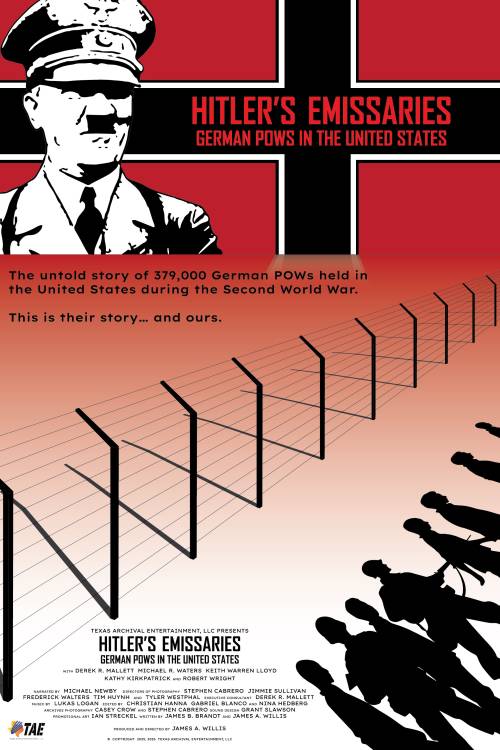
This documentary reveals the untold story of 379,000 German POWs held in the United States during World War Two. This is their story… and ours.
Likely the most comprehensive film on the subject ever produced, the information-packed, three-and-a-half-hour production departs from the traditional documentary by going deep beyond the story’s surface. The film not only explores the decision to bring some of the most ideological and dangerous men of the twentieth century to all corners of the United States but the challenges that action brought with it. For example, how the U.S. program was developed, implemented, funded, and staffed when the majority of military-age Americans were already serving overseas.
Prisoners from all three Axis Powers (Germany, Italy, and Japan) were brought to the United States during the war. Over a quarter-of-a-million of these were from Nazi Germany, by far the largest contingent of the three countries.
The prisoner of war program was entangled in an array of logistics from the start. These included the transportation of combatants to the United States from multiple theaters of the war, feeding and housing them, abiding by international agreements regarding POW treatment, scouring the country for those that could design, build, maintain, command, and above all, guard the prisoners at the new camps.
As with any massive war-time bureaucracy, there would naturally be hitches in the system along the way. While the United States was aware of the threat posed by the Nazis, the fanatic nature of some of their hardcore members still came as somewhat of a surprise. The increasing danger posed by these zealous Nazis to American personnel and even their fellow German POWs was a serious concern.
Ultimately, this led to the decision to build a high security facility in Oklahoma where the most radical of these men would be transferred. While this installation kept many of the known troublemakers far away from other German prisoners, it did not entirely solve the problem.
Many die-hard Nazis stayed off the American radar, hiding in plain sight. This allowed them to operate underground networks throughout the entire U.S. camp system. These men could track fellow prisoners that were considered unloyal to the Nazi cause, trade secret messages through a sophisticated campaign involving the U.S. Prisoner of War Mail Service, and set-up clandestine Party Courts within the camps that would punish their own men for crimes -- real, imagined or invented.
While all of the German POWs were representatives of Hitler’s Third Reich, these men did not always embrace the same social and political beliefs. In fact, there were basically three types of Germans held in U.S. facilities: the devoted Nazis, those simply loyal to their country or neutral conscripts, and the anti-Nazis. Placing these three categories of soldiers together, even after the segregation of the worst of the Nazi element, created a life and death struggle that played out within the camps, one that pitted German against German.
This is their story, and ours, illustrating the film’s wide-ranging coverage of the camp system by chronicling both sides, the captives as well as the captors.
Cast & Credits
Cast: Derek R. Mallett, Dr. Michael Waters, Kathy Kirkpatrick & Keith Warren Lloyd
Narrated by Michael Newby
Produced & Directed by James Willis
Written by James Brandt & James Willis